

Wisdom Tooth Pain: Symptoms, Causes, When to Remove an Impacted Wisdom Tooth & Treatment in Noida
Experiencing pain at the back of your jaw? Having difficulty chewing, swollen gums or discomfort while opening your mouth? These symptoms could be associated with an erupting or impacted wisdom tooth.
Wisdom tooth pain is a common dental concern, particularly in young adults. While some wisdom teeth erupt normally without causing problems, others may become partially erupted, trapped beneath the gums or grow at an incorrect angle.
Understanding the symptoms and knowing when to seek dental treatment can help prevent complications.
At Zenith Dental Care, Sector 37, Noida, we believe that timely diagnosis and appropriate treatment are essential for maintaining good oral health.
What Is a Wisdom Tooth and When Does It Erupt?
Wisdom teeth are the third molars located at the extreme back of your mouth. Most people develop up to four wisdom teeth, one in each corner of the mouth.
They generally erupt between the ages of 17 and 25, although the timing varies from person to person.
Sometimes, there is insufficient space in the jaw for these teeth to erupt properly. As a result, they may remain partially or completely trapped beneath the gums. This condition is known as an impacted wisdom tooth.
Why Does Your Wisdom Tooth Hurt?
Wisdom tooth pain can occur for several reasons:
- Insufficient space: Lack of adequate room may prevent the tooth from erupting normally.
- Impaction: The wisdom tooth may grow sideways, at an angle or remain trapped beneath the gum.
- Gum infection: Partially erupted wisdom teeth can create spaces where food particles and bacteria accumulate.
- Pericoronitis: Inflammation or infection of the gum tissue surrounding a partially erupted wisdom tooth.
- Tooth decay: Difficult-to-clean wisdom teeth may develop cavities.
- Pressure on neighbouring teeth: An incorrectly positioned wisdom tooth may affect the adjacent second molar.
Identifying the underlying cause is important before deciding on the appropriate treatment.
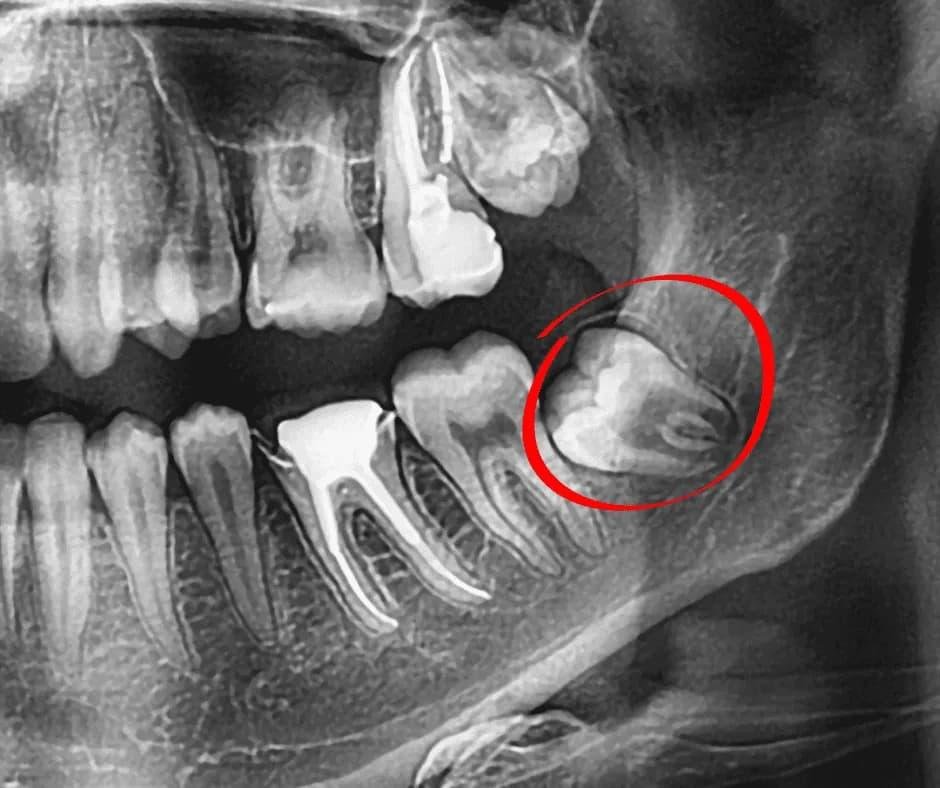
7 Common Signs of an Impacted Wisdom Tooth
An impacted wisdom tooth may cause one or more of the following symptoms:
1. Pain at the back of the jaw
Persistent or recurring discomfort behind the last molar can indicate an erupting or impacted wisdom tooth.
2. Swollen or painful gums
The gum tissue surrounding a partially erupted tooth may become inflamed, tender or swollen.
3. Difficulty chewing
Pain and inflammation around the wisdom tooth can make chewing uncomfortable.
4. Difficulty opening your mouth
In some cases, inflammation associated with an impacted wisdom tooth can cause restricted mouth opening.
5. Bad breath or unpleasant taste
Food debris and bacterial accumulation around a partially erupted wisdom tooth may contribute to bad breath or an unpleasant taste.
6. Recurrent gum infections
Repeated episodes of swelling, tenderness and inflammation around the same tooth may indicate pericoronitis.
7. Pain spreading towards the ear or jaw
Wisdom tooth-related discomfort may sometimes radiate towards the ear, temple or surrounding jaw region.
If you experience facial swelling, fever, difficulty swallowing or rapidly worsening symptoms, seek urgent dental assessment.
Can an Impacted Wisdom Tooth Cause Infection?
Yes. A partially erupted wisdom tooth can create a flap of gum tissue that traps food particles and bacteria.
This may lead to a condition called pericoronitis, characterised by:
- Swollen and tender gums
- Pain while chewing
- Difficulty opening the mouth
- Unpleasant taste or bad breath
- Occasionally, pus formation and fever
If left untreated, an infection may spread into surrounding tissues. Severe or spreading infections require urgent professional assessment.
Does Every Wisdom Tooth Need to Be Removed?
No. Not every wisdom tooth requires extraction.
If a wisdom tooth has erupted completely, is correctly positioned, can be cleaned properly and is free from disease, it may be retained.
However, removal may be recommended when the wisdom tooth:
- Causes repeated pain or infection.
- Is impacted and associated with disease.
- Develops extensive tooth decay that cannot be predictably restored.
- Damages the neighbouring second molar.
- Is associated with certain cystic or other pathological changes.
A clinical examination and appropriate dental X-ray help determine whether extraction is necessary or whether monitoring is sufficient.
When Is Wisdom Tooth Extraction Recommended?
Wisdom tooth extraction may be advised when there is a clear clinical indication.
Depending on the tooth's position, the dentist may recommend a straightforward extraction or a surgical procedure.
An X-ray helps assess the tooth's position, root anatomy and proximity to important structures such as the inferior alveolar nerve in the lower jaw or the maxillary sinus in the upper jaw.
The treatment approach is individualised according to the complexity of the case.
Is Wisdom Tooth Removal Painful?
Wisdom tooth removal is generally performed under local anaesthesia, which numbs the treatment area.
You may experience pressure or movement during the procedure, but sharp pain should not be expected when adequate anaesthesia has been achieved.
Some discomfort, swelling and tenderness after extraction are normal and usually improve over the following days.
Your dentist will provide appropriate postoperative instructions and medication when required.
What Happens During Wisdom Tooth Extraction?
The procedure depends on whether the tooth is fully erupted or impacted.
For a straightforward extraction:
- The area is numbed using local anaesthesia.
- The tooth is gently loosened.
- The tooth is removed.
- Post-extraction instructions are provided.
For surgical wisdom tooth removal:
- Local anaesthesia is administered.
- A small incision may be made in the gum.
- A small amount of surrounding bone may need to be removed.
- The tooth may be sectioned into smaller pieces for controlled removal.
- Stitches may be placed when required.
Not every impacted wisdom tooth requires all these steps. The procedure depends on its position and surgical complexity.
How Long Does Recovery Take After Wisdom Tooth Removal?
Recovery varies depending on the difficulty of extraction and individual healing.
Most patients experience some swelling and discomfort during the first few days. These symptoms generally begin improving gradually.
For a smoother recovery:
- Follow your dentist's postoperative instructions.
- Avoid vigorous rinsing or spitting during the initial 24 hours.
- Avoid smoking and alcohol during healing.
- Choose soft foods initially.
- Maintain oral hygiene without disturbing the extraction site.
- Take prescribed medication as directed.
Contact your dentist if pain or swelling becomes progressively worse, you develop fever or you experience persistent bleeding.
When Should You Visit a Dentist for Wisdom Tooth Pain?
Do not ignore recurring pain or swelling at the back of your mouth.
You should arrange a dental consultation if you experience:
- Persistent wisdom tooth pain.
- Repeated gum swelling or infection.
- Difficulty chewing or opening your mouth.
- Food getting trapped around the last molar.
- Pain affecting your sleep or daily routine.
Early assessment can help identify the cause and prevent avoidable complications.
Looking for Wisdom Tooth Treatment in Noida?
Wisdom tooth pain can interfere with eating, sleeping and everyday activities. Whether your tooth is erupting normally, partially impacted or causing recurrent infection, an appropriate dental evaluation is the first step towards deciding the right treatment.
At Zenith Dental Care, Sector 37, Noida, patients can receive an individualised assessment for wisdom tooth pain, impacted wisdom teeth and wisdom tooth extraction.
Our approach focuses on accurate diagnosis, patient comfort and explaining the available treatment options before proceeding.
Experiencing wisdom tooth pain? Don't wait for the discomfort to worsen.
Book your dental consultation at Zenith Dental Care.
Zenith Dental Care
207, Sector 37, Noida – 201303
Phone: 9971414473 / 7042563914
Website: https://www.zenithdental.in/
Frequently Asked Questions About Wisdom Teeth
1. How do I know if my wisdom tooth is impacted?
Pain at the back of the jaw, swollen gums, difficulty chewing and recurrent infections may indicate an impacted wisdom tooth. A dental examination and X-ray help confirm the diagnosis.
2. At what age do wisdom teeth usually erupt?
Wisdom teeth commonly erupt between 17 and 25 years of age, although they can erupt earlier, later or remain impacted.
3. Can wisdom tooth pain go away on its own?
Mild discomfort during eruption may settle, but recurring pain or swelling should be evaluated by a dentist. Temporary relief does not necessarily mean the underlying problem has resolved.
4. Is wisdom tooth extraction always necessary?
No. Healthy, functional wisdom teeth that can be maintained properly may not require removal. Extraction is recommended when there is a clinical indication.
5. How many days does wisdom tooth pain last after extraction?
Discomfort is generally most noticeable during the first few days and gradually improves. Recovery varies with the complexity of extraction.
6. Can an impacted wisdom tooth cause facial swelling?
Yes. Inflammation or infection around an impacted wisdom tooth can cause swelling around the jaw and cheek. Significant or spreading swelling requires urgent assessment.
7. Is wisdom tooth removal a surgical procedure?
Not always. A fully erupted wisdom tooth may be removed through a straightforward extraction, whereas an impacted tooth may require surgical removal.
